





When you think about lactation, your thyroid probably isn’t the first thing that comes to mind. We often think about lactation as a simple “supply and demand” model, where the breast supplies milk as the baby feeds and “demands” it. This model is easy to troubleshoot by adding in things like pumping or addressing latch.
However, lactation is also heavily impacted by different hormones, including prolactin, oxytocin, and more. When those troubleshooting ideas from the “supply and demand” model aren’t working, this is where we might need to start looking at what is going on with your hormones. And that’s where the thyroid comes in.
Thyroid Hormones
The thyroid produces hormones that act as a “thermostat” telling your body how fast or slow to run. This includes:
- metabolism speed (how your body burns calories and creates energy)
- body temperature
- heart rate
- the speed of your digestion, and more.
There are thyroid hormone receptors on every cell in your body. Energy from the process of metabolism even powers the mammary (breast) cells that work to produce milk. There are two forms of this hormone, T3 (the active form) and T4 (the inactive form), both of which require iodine to be made.
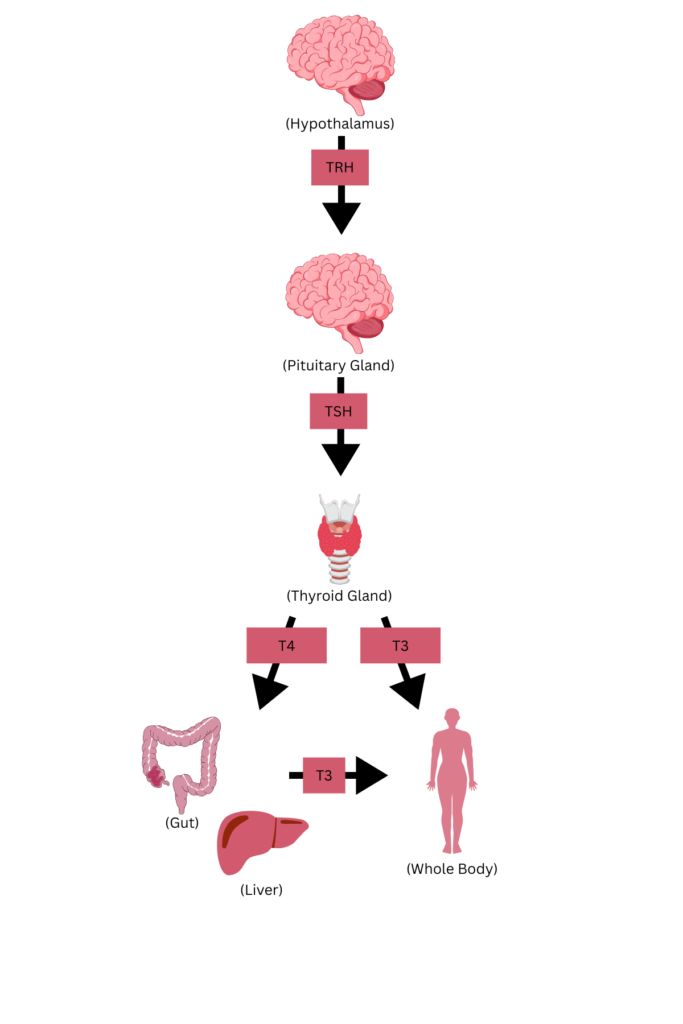
Your thyroid stimulating hormone (TSH) in your brain, produces T4, which travels through the body, but it must be converted into T3 (the active form) in order to be used by the body, a process that occurs mostly in the liver, but also in the gut. This conversion process uses iron, selenium, dopamine, and serotonin in the liver, and zinc, selenium, vitamin A, and vitamin D in the gut to convert the inactive form of T4 into T3, which then plays on the cellular level.
The pathway that the body uses to make thyroid hormones goes like this: the hypothalamus monitors the levels of thyroid hormone in the body and releases thyrotropin releasing hormone (TRH), TRH goes to tell the pituitary gland to release thyroid stimulating hormone (TSH), and TSH goes to tell the thyroid to produce lots of T4 and a little bit of T3.
There is one more version of thyroid hormone called reverse T3 (or RT3). This version is produced during times of illness, stress, and calorie deprivation, and it tries to convince the body to “rest” and preserve T3 by preventing T4 from being converted to T3.
Below is a visual to help show this process.
Prolactin and the Thyroid
Prolactin is the hormone that stimulates breast development and milk production. Like TSH, prolactin is made in the pituitary gland, and TRH tells this gland to make both prolactin and TSH. The more TSH you ask the pituitary gland to make, the less prolactin it can make. Therefore, issues with thyroid hormone (like high RT3 or low T3) can show up as issues with milk supply.
Iodine
Another very important connection between the thyroid and lactation can be found in the nutrient iodine.
Iodine is extremely important for breast tissue health, and it is also a necessary component of thyroid hormones. The breast and the thyroid will compete for iodine, so this is another reason that issues with the thyroid might show up as issues with milk supply.
When you do not have adequate iodine intake, the thyroid will not be left with enough to make adequate thyroid hormones. Therefore, the hypothalamus will tell the pituitary gland to make lots and lots of TSH thinking it will help make more thyroid hormone, which makes it harder for the pituitary gland to make prolactin. That is why milk supply might struggle.
Iodine can be found in foods like fish (salmon, sardines, halibut, cod etc), seaweed, dairy products, cranberries and some meats.
Adrenals and Cortisol
Many other hormones in the body are also interconnected with the thyroid, including cortisol, which is produced by the adrenal gland. Therefore, thyroid and adrenal issues tend to go together. When you are in a state of chronic stress (high cortisol), the extra cortisol does not allow T4 to be converted to T3, and it also increases the production of RT3.
This slows down your metabolism and will lead to similar issues with telling the pituitary gland to make lots of TSH and reduce the production of prolactin. Eventually, the adrenal gland will get burnt out from making so much cortisol, leading to exhuastion. Adrenal fatigue leads to low energy and weakens the thyroid’s response. Because of the way that adrenal fatigue impacts the thyroid and pituitary gland, there can be similar issues with milk supply.
What can you do to support your thyroid?
Addressing Adrenal Fatigue
Supporting your adrenal gland in getting back to making its normal levels of cortisol can be a huge help to your thyroid. Supporting healthy sleep habits and regulating your circadian rhythm is a great place to start. This blog post features more information on supporting healthy sleep habits.
Drinking more water and incorporating more minerals for adequate hydration can also make a difference. Try aiming to drink 80oz of water and incorporating one or two mineral mocktails in your day. Check out our mineral guide for more information!
Ensuring you’re eating enough and having balanced blood sugar is going to be huge for your adrenals. Eating breakfast within an hour of waking up, eating every 2-3hrs (max 4hrs) with meals combining protein, fiber and healthy fat.
Finally, finding one or two ways to destress can allow your adrenal gland to recover as well. You could try incorporating journaling, reading, painting/coloring, taking a daily walk, or any other hobby that you enjoy and find restful.
Medication
Oftentimes, people with low levels of thyroid hormones will be prescribed the medication levothyroxine, which is a synthetic version of T4. However, taking levothyroxine will not help solve any issues with the conversion of T4 to T3, so it might not help depending on the root cause of your thyroid dysfunction.
Another medication, called liothyronine, is the synthetic version of T3. Taking liothyronine might help bypass any issues with the conversion of T4 to T3. However, if you can, it is likely best to address the root causes of thyroid issues and instead use food as medicine.
Food as Medicine
There are several different nutrients that you can try adding more of into your diet to help out your thyroid therefore supporting lactation.
Iodine
As we discussed, iodine is one of the most important nutrients in both thyroid function and in breast health, so incorporating more iodine could be a great way to address thyroid issues. Good sources of iodine include seaweed, fish, iodized table salt, and some dairy products.
Omega-3s
Omega-3s are fatty acids that are important for reducing inflammation and for helping the hypothalamus do its job. Some omega-3-rich foods include fatty fish like salmon, chia seeds, flax seeds, walnuts, and edamame.
Vitamin D
Vitamin D is another nutrient that helps reduce inflammation, and it also plays a part in the conversion of T4 to T3. Sources of Vitamin D include eggs and some fish, such as salmon. It is also created from sun exposure, so getting outside can also help.
Magnesium
Magnesium is extremely important for supporting adrenal function because it supports sleep, helps prevent excess cortisol from being made, and supports the creation of adrenal hormones. Some sources of magnesium are green leafy vegetables, nuts and seeds, beans, and whole grains.
NAC (N-Acetyl Cysteine)
While not found directly in foods, NAC is an important compound that helps reduce inflammation and make an antioxidant called glutathione that protects and aids both the liver and the thyroid. Cysteine, which is the precursor for NAC, can be found in foods such as poultry, dairy products, eggs, nuts and seeds, and beans. However, an NAC supplement could also be helpful.
The Bottom Line
Your body is complex and involves many different hormones that work together to support your health and wellbeing as well as milk supply. Having even a basic understanding of these hormones can go a long way in helping you learn how to navigate your health. In this blog post I share some examples of thyroid symptoms to understand what is normal and what isn’t.
Need more help for your specific needs?
We are here for you, offering one-on-one functional nutrition coaching! We can chat to determine whether your specific symptoms might point to a thyroid issue, as well as do lab testing to confirm. We can also provide tailored nutrition and lifestyle recommendations to help you heal your thyroid and breastfeed and feel your best. Click here for more information!